Page 1 of 1

The Empire of Tian Xia

Posted: Sat May 25, 2013 3:36 pm
by Darrik
Links for ease of navigation

Part One: A History/Timeline of Tian Xia http://www.tharshaddin.com/rp/viewtopic ... 097#p35018

Part Two: Races + Societal structure and hierarchy http://www.tharshaddin.com/rp/viewtopic ... 097#p35019

Part Three: Geographical and political divisions, Areas of Note http://www.tharshaddin.com/rp/viewtopic ... 097#p35020

Part Four: Military structure of Tian Xia http://www.tharshaddin.com/rp/viewtopic ... 097#p35021

Part Five: Magic and the Supernatural within Tian Xia http://www.tharshaddin.com/rp/viewtopic ... 097#p35022

Part Six: The Legal Code of Tian Xia http://www.tharshaddin.com/rp/viewtopic ... 097#p35023

Part Seven: The Jinyiwei http://www.tharshaddin.com/rp/viewtopic ... 079#p35079


=====Drafting Updates=====

---Complete (or almost so)---

+ History/Timeline is basically complete.
+ Notes on the Government and Races of Tian Xia are mostly complete
+ Geographical Divisions and Areas of Note is basically complete
+ Magic in Tian Xia is basically complete, but there is room for more variation as people come up with ideas.
+ The Imperial University of Magical Studies and its main areas of magical study have been described (though the facility itself hasn't).
+ Laws and Law Enforcement section mostly complete
+ Added the Nian Shou Pirate Fleet as a separate world dev entry: http://www.tharshaddin.com/rp/viewtopic.php?f=40&t=3112


---To-Do List---

+ Cities: The Imperial Capital (Creation + Description + Map), Main Trade City, Ji (Rough description, maybe map)
+ Notes on the Military Organisation of Tian Xia are probably about half done, but need further expansion - specifically regarding the Weisuo system, as well as the structure and composition of the three armies and navy.
+ Update other sections based on the new details regarding magic use within Tian Xia, as well as the Imperial University of Magical Studies.
+ Notes on Tian Xia etiquette
+ Monsters Monsters Monsters! (Demons, Ghosts, and various nasties from chinese folklore remade for the AU Tian Xia.) ...and the people who hunt them (now largely covered in the Magic of Tian Xia section)


+ I'm considering a separate World Dev thread for the Fenghuang Monks and the Kunlun Temples
+ Possibility for Naga race in the jungles of Nanyue and nearby regions. Would likely also require it's own thread. http://en.wikipedia.org/wiki/N%C4%81ga


As you can see, a lot remains to be done, but there is progress! As always, I am more than happy to share thoughts and brainstorm with folks on any aspect of the drafting process.

Already I have dozens of character concepts begging me to make applications for them, so I shall try to finish the draft of Tian Xia here as soon as is feasibly possible.


=============================Original Message==============================

Hello all! As you probably noticed from my writers resources thread, I've been heavily researching things with an eye for creating an application to develop Tian Xia.

As of now, I have enough of an outline to put together a skeleton of where I am heading with this, and have stolen several 'Replies' to facilitate ease of organisation.

===Post Structure===

This Post: Index and explanation of why I want to develop Tian Xia
Post One: History/Timeline of Tian Xia
Post Two: Races + Societal structure and hierarchy
Post Three: Geographical divisions, Areas of Note
Post Four: Military structure/organisation
Post Five: Magic in Tian Xia (Feng Shui/Kan Yu, I Ching/Yi Jing, Taoist Exorcism magics, and Qi)


===Why Tian Xia?===

TL:DR - Because it looked too awesome not to? (Also, I get obsessed easily.)

Long Version -
Ever since I watched my first badly dubbed Bruce Lee movie as a small child, I fell in love with pre-communist China. Or at least, the Pre-Communist china portrayed in fiction. Films in the Wuxia Genre particularly captivated me, with its over-the-top heroes and villains plus good-triumphs-over-evil motif.

When I saw Tian Xia languishing as a huge continent with not much recorded RP, I felt I had to rectify things.


===The thoughts which started me on this project===

After a conversation on chat, I recorded my thoughts of the time, with a couple of subsequent additions, to help keep my focus during initial research, which I have copied here:

In much the same way Jaspanella has with Korea (Gur'yeo), I'm using medieval and ancient china as my springboard and base skeleton from which to flesh out the Alternative Universe variant. I agree with Orban's points regarding heritage, and view the Imperial structure more like the complex bureaucracy of the Song and Ming Dynasties

However, I envision much of the Imperial infrastructure and bureaucracy being most effective and efficient in the central plains - the outerlying tributaries and domains would be more autonomous (such as the vast steppes in the north, and the deserts to the west)


Where the big difference will be, and where I have the most work cut out for me, is in how has the empire been affected by, and responded to, magic?

I like the notes that the emperor is a benevolent and competent leader, who doesn't think of himself as a god.

However, I'd like to explore the idea of that being 'in spite of the fact' the emperor and his family are benevolent dragon shifters (oriental serpent dragons, not the western winged variety)

Because, in a world where magic and mages and shifters are common: it would take a badass family to rule an empire as large as Tian Xia, and maintain the awe and loyalty for the 'imperial mandate' to make sense

The idea of dragons as a ruler came from this: http://en.wikipedia.org/wiki/Dragon_King

But, rather than being answerable to the 'Jade Emperor Yu Di' of chinese mythology (who I suggest could be the Tian Xia Changer), the Emperor is also a dragon.

Because Dragon Mythology has been around in China from before the changer wars, it occurs to me that this family of dragons had a long-standing link to the continent even before the seal was broken which gives them this sense of noblesse oblige towards the lesser beings in 'their territory' (i.e Tian Xia) so they moulded a civilisation over centuries

What I like about ancient and medieval China is that it wasn't a homogenous population. There were all kinds of cultures rambling around doing their thing in their areas, even though being part of the empire

I hope Tian Xia will be like that too: a melting pot of varying cultures, where the 'pot' is the imperial structure and bureaucracy holding it all together

===Basic notes on the rulers: the Dragon Shifters of Tian Xia===

(You will note, by some of my translations in brackets, that I have been very 'white man unoriginal' in creating the names. Chinese players, now and future, I beg your forgiveness =p )


Family Name: Tianlong (Heavenly Dragon)

Emperor: Tianlong Huangdi (Heavenly Dragon Emperor)
Empress: Tianlong Wangmu (Heavenly Dragon Queen Mother)
Admiral of Vast Eastern Seas: Tianlong Guang
Great General of the North: Tianlong Shun
Great General of the South: Tianlong Qin
Great General of the West: Tianlong Run


Given the immense size of Tian Xia, were it not for the power and near-immortal longevity of the Tianlong dragon shifters, an empire so large would inevitably collapse in upon itself within a few generations.
It is the stewardship of the inseparable Tianlong dragons which allows the empire to remain in its form.

And so it is that the Emperor and Empress reside in the capital of (Ji? Is the Tian Xia capital already established, or is there some flexibility in choice of location for a capital?) in the central plains of China
Tianlong Shun is regent over the russian/mongolian landmass
Tianlong Qin looks after the landmass covering down to the straits of Malacca
Tianlong Run oversees the entire western border and trade routes (which allows Shun to focus on internal policy in the northern provinces, and leave border issues to his brother)
Tianlong Guang has authority over the waters and navy of the empire

That such a powerful family can remain united in a common cause without conflict comes from an important trait:
The dragons share their thoughts, like a hive mind, being inextricably linked to each other: though they are many, they are are one.

When in human form, these golden-eyed shifters bear an aura so inhumanly serene as to inspire a kind of awe in less powerful creatures. A unique and magical biology has allowed the Tianlong a form of virtual immortality: Tianlong aging starts in their scales, a result of exposure to the physical world (rather than their original home in the Astral Plane), but the Tianlong learned the signs, and developed the ability to shed their skin like a snake. The process takes a week to complete, and in the year after shedding their new scales are soft and lack the magical robustness of matured scales. This makes the Tianlong physically vulnerable to standard weapons. As a result, the Tianlong do not advertise how they remain immortal, and are careful in how they explain their weeklong absences. They only need to shed every two hundred years, and have developed secret medicinal uses for the shed scales.

Re: The Empire of Tian Xia

Posted: Sat May 25, 2013 3:36 pm
by Darrik
=====Part One: A History/Timeline of Tian Xia=====

(To assist myself in keeping track, I have recorded both CE and PW notations side by side where applicable)

Tian Xia was not always the sprawling empire of the modern day. Indeed, at the time of magic's proliferation around 1000 BCE, the Zhou Dynasty barely covered a fifth of the expanse of present day Tian Xia. However, it was the humble beginnings of the Zhou Dynasty which would develop over time into the vast empire ruled by the present Tianlong Dynasty.

It is commonly said by Imperial Scholars that the reign of the Zhou Dynasty from 1046 BCE to 256 BCE was the Reign of Magic, for the introduction of magic into the Zhou empire greatly superseded in influence the simultaneous discovery and introduction of iron into Tian Xian manufacturing. However, as a result of the Changer War, the powerful Dynasty came to an end six years prior to the end of the war, and was superseded by the intervention of the Tianlong family.

The Zhou Dynasty remains a popular area of study amongs Tian Xian scholars preparing for imperial examinations. New archaeological evidence from the era is often hailed with great ceremony in academic circles.


===The Zhou (or Jade) Dynasty (1046 BCE to 256 BCE)===

=Rise of the Jade Emperor, Yu Di (720 BCE - 256BCE)=

* A powerful Dragon Changer, Yu Di's appearance singlehandedly altered the dynamic of Dynastic Structure within Tian Xia. Ruling with absolute godlike authority for several centuries the more formally titled 'Yu Huang Shangdi' created in his subjects a habitual tolerance for long standing dictatorship within the continent - a cultural precedent which the Tianlong shifters would eventually leverage when claiming the Jade Throne after the end of the Changers' War.

Little concrete is known of Yu Huang Shangdi, though anecdotal evidence from legend suggest that his name came from the jade scales of his Changed form.


=The Changers' War (600BCE - 250BCE)=


* With the Changers' War on his doorstep Yu Huang Shangdi was eventually forced to become involved despite a disinterest in the affairs of other nations, having previously preferred to shape the lands within Tian Xia to his will. Eventually, the Jade Emperor met his end during the Changers' War around 256 BCE.

* During this period the Tianlong family of serpentine dragon shifters entered Tian Xia from the Astral Plane at around 310BCE. Details of their participation in the Changers' War remain unclear, save for their usurpation of the empty Jade Throne at 256BCE


=The Rage of Heaven (310BCE)=

* At the grim crescendo of the Changers' War the Earth's orbit and axis were altered. Large portions of the continent were submerged, with two new inland seas formed: one in what had been the Sìchuān Basin, the other covering the plains north of the Saian mountains and as far east as what had been lake Baikal.

At present day these bodies of water remain known as the Sìchuān Sea and the Baikal Sea.


===The Warring Races period (256BCE to 110CE/2176PW)===

* A half century after the planet's axis and orbit were altered in the Changer War, when the surviving inhabitants of Tian Xia had recovered enough for self-interest to take its hold in the hearts of the dispossessed and disgruntled, a centuries-long period of civil war began between the various races and cultural cross-sections within Tian Xia. The territorial conflicts were eventually ended by the military exploits of the Tianlong family.

* It was during this time that the original Marn fell to Tian Xian forces belonging to a western warlord who found eastern expansion blocked by another warlord and saw the benefit of controlling a fort on the trade route. Marn remained an outpost for many years, though even under during the Tianlong Dynasty it was considered an extreme outpost, barely worth the infrastructure required to keep it supplied and loyal to the empire.


===The Tianlong Dynasty (110CE/2176PW to Present)===

=Imperial Consolidation (110CE/2176PW to 376CE/1910PW)=

* A period of militaristic expansionism, colonialism, and consolidation of Tianlong imperial authority taking advantage of the chaos following the end of the Changers War and the closing of the Astral Seal. The three great Tianlong generals - Run, Qin, and Shun - eventually constrain the constant conflict afflicting the continent within the boundaries of imperial order and infrastructure.

* During this period Emperor Tianlong Huangdi and Empress Wangmu established the imperial examinations and nine-badge ranking system, underpinning the new bureaucracy with the tenets of meritorious advancement. Corruption was established as a crime punishable by capital punishment. In this era the Jinyiwei were formed: its initial mandate was to hunt out corruption and treason before it could affect stability of the burgeoning empire, but was soon expanded to hunt down any magic users and monsters whose actions threatened imperial stability.

* It was also during this period that an assassination attempt was made on the Emperor in the Hall of Audience. Henceforth, a standing army was raised to protect the heart of empire for all posterity.


=The Nian War (376CE/1910PW to 388CE/1898PW)=

* A family of ocean-dwelling shifters, resembling scaled tigers, begin raiding the coastal territories of Tian Xia in the final years of the consolidation period. With the aid of a coalition of pirates and creatures warped by the Changers' War, the powerful Nian tribe caused havoc for a little over a decade until a battle between the invaders' leader Nian Shou and Admiral Tianlong Guang forced the invaders to retreat and resulted in the development of a stronger navy. The victory over the Nian would form the precursor of all future piracy, as future generations of the long-lived Nian would continue their vendetta by supporting pirates in the waters off Tian Xia


=The Fenghuang Prosecution AKA the Western Temple Wars (1377CE/910PW – 1437CE/850PW)=

The Fenghuang shifters' life of monkish contemplation in the Kunlun Mountains with their followers was largely ignored by the empire for many years, during which time they came to their own understanding of how the material and astral plane inter-related. The Fenghuang explained their understandings through the notion of Qi, or universal energy. Through their own studies and exercises the Fenghuang came up with programs of meditative breathing and martial arts which allowed even the magically untalented to harness some aspect of the universal energy: a process they termed Qigong. Kunlun monks had a strong belief in the individual's ability to shape their fate, and that of the world around them, and a trend began of vigilante monks travelling the countryside to right wrongs and use their abilities to bring bandits to non-imperial justice. The difference in philosophy between the Fenghuang-run temples and Tianlong Imperial Bureacracy led to the now-infamous conflict after what had been a 1000 years of peaceful, if strained, co-existence.

The remote, defensible nature of the temples in the Kunlun mountains and presence of the potent Fenghuang abbots, coupled with the Qigong of even the lowliest monks, resulted in a stalemate to the conflict. Eventually, an armistice was arranged between the Tianlong and Fenghuang, and the Kunlun Monks of present day still maintain the right to roam freely and teach their philosophies to any who listen, a privilege which over the centuries has led to a proliferation of martial arts throughout Tian Xia.

* During this period of internal strife, forces from the Western empire conquered Fort Marn. Tianlong Huangdi deemed it an inefficient use of military resources to make any attempt to regain the fort. Tian Xia's efforts, after the conclusion of the Western Temple Wars, were instead directed to consolidate Western border security and an improvement in oversight procedures for critical border access points.


=The War that Was Not (1437CE/850PW to 1967CE/320PW)=

* With Marn in possession of the Western Empire, Tian Xia remained in a state of constant military readiness and developmental research. Though there was never an outright war or pitched battle beyond the odd skirmish between scouts, this centuries-long state of affairs is largely responsible for the present-day habit of maintaining a similar state of military readiness. 'The War that Was Not' period officially ended when Marn was abandoned by the Western Empire.


=Splendid Isolation (1967CE/320PW to Present)=

* Although its ports and trade routes remain open to foreign merchants and traders, Tian Xia has become a largely inward-looking culture, viewing itself as the pinnacle of civilisation.

Though this is largely a happy fiction maintained through a biased world view it is true that, aside from the fact Tian Xia effectively remains a benevolent and persistent imperial dictatorship, the meritocracy system built into all levels of civil service and the machine of bureaucratic governance allows Tian Xian citizens a comparatively decent quality of life. So long as you aren't born to the wrong parents, or in the wrong place, or fall in with the wrong crowd.

One bitter and subsequently discredited scholar infamously proclaimed in his entrance examination "From every torch held up to represent 'enlightened culture' there is cast a shadow of prejudice and carefully ignored inequality."

=Recent Events of the Past 50 Years=

* The military expedition of 139PW:
To prevent the stagnation of the military a reconnaissance-in-force against Eyropa was sanctioned and launched along the Northern and Southern traderoutes into Eyropa, resulting in a pitched battle on a Thar west of Shaddin. The northern Tian Xia forces, relying mostly on military might, numbers, and centuries-old military doctrine, were not prepared for the combination of military and magic might the Eyropans brought to bear on their forces. With the failure of the Southern Tian Xia forces to arrive as planned, the defeat was almost absolute. It was only the Tian Xian Northern army's finely honed discipline even in the contingency of defeat which ensured that a detailed report of the battle and defeat reached Great Generals Tianlong Shun and Run. It was around this time that Zhou Lei arrived in Marn.

* An Eyropan counter-expedition against Tian Xia was soundly defeated with the personal intervention of the Great Generals of the North and West, and subsequently a period of intense military and magical reform began in Tian Xia. The emperor Tianlong Huangdi's 'Mandate of Reform in Magic and Military Application and Organisation' has been in progress for fifteen years prior to present day.

Re: The Empire of Tian Xia

Posted: Sat May 25, 2013 3:37 pm
by Darrik
=====Part Two: Races + Societal structure and hierarchy=====


====The Imperial Government of Tian Xia====

The infrastructure supporting the Tianlong Dynasty's rule of Tian Xia is referred to as 'The Sānshěng Liùbù', or 'The Three Departments and Six Ministries'.
Although the Emperor is the Supreme Ruler of Tian Xia, it is the Empress Tianlong Wangmu who heads the Sānshěng Liùbù, and it the Empress to whom the department and ministry heads report.

The Emperor sits in the Hall of Audience which allows citizens of Tian Xia to, by appointment, approach the Emperor personally with requests.
Any requests approved and requiring action are passed to the Secretariat

===The Three Departments===

==Secretariat==

Responsible for proposing and drafting Imperial Decrees, as well as ensuring that approved decrees are disseminated through the empire efficiently.
Members of this department are chosen based on superlative communication skills and an expansive understanding of imperial governance and infrastructure.


==Edict Examination Bureau==

Policy advisors to the Secretariat and Tianlong family. There are sections to this department which correspond with the six ministries, ensuring that the Secretariat and Emperor has ready access to informed and educated advice.
Members of this department are chosen based on exemplary expertise and experience in their respective fields.


==Department of State Affairs==

Responsible for maintaining and operating the Six Ministries
Each ministry is headed by a minister and two sub-ministers, each chosen for experience in their respective fields and superior ability to manage people effectively.


=The Ministry of Personnel=

In charge of appointments, merit ratings, promotions, and demotions of officials, as well as granting of honorific titles.


=The Ministry of Revenue=

In charge of gathering census data, collecting taxes, and handling state revenues


=The Ministry of Astral Influence=

Responsible for the certification of Imperial magic users, gathering of rumour and news with regards to magical and supernatural occurrences, and oversees the Imperial University of Magical Studies.
Includes a subministry in charge of state ceremonies and rituals.


=The Ministry of Defense=

In charge of the maintenance of military installations, equipment, and weapons, as well as the courier system. Oversees the infrastructure and logistics of keeping the Four Great Generals adequately supplied.


=The Ministry of Justice=

In charge of judicial and penal processes, as well as assigning and maintaining a list of regional and roaming magistrates.


=The Ministry of Works=

In charge of government construction projects, hiring of artisans and laborers for temporary service, manufacturing government equipment, the maintenance of roads and canals, standardization of weights and measures, and the gathering of resources from the countryside.
Oversees the Dwarven and Gnomish manufacturing guilds.


===The Imperial Examinations===

The Imperial Examinations are designed to select the best potential candidates to serve as administrative officials, for the purpose of recruiting them into The Three Departments and Six Ministries.

Strictly speaking, anybody is permitted to take the Imperial Examinations in an attempt to obtain employment within the government.
There are set curriculums for each department or ministry, encouraging a uniform understanding of those principals which underpin the Tianlong Dynasty amongst its diverse citizens.

There are, however, caps set on the number of applicants able to succeed at each level of the examinations, starting at the local county level, advancing to provincial level, and finally imperial level.
Fierce competition is prevalent, as are innovations in cheating and the discovering of cheaters.

Each student taking the exam is taken to a special examination compound. and is provided with only a few amenities: a water pitcher, a chamber pot, bedding, food, an ink stone, ink, and brushes.

Guards verify the students' identities and search them for hidden printed materials. Each exam taker spent three days and two nights in a tiny room with a makeshift bed, desk, and bench. There were no interruptions in those three days, nor were candidates allowed any communication.

Duringthe examination period the applicants compose numerous essays related to subject matter involved in their chosen department or ministry. These essays would need to cover basic facts and procedures, evaluation and resolution of several difficult problems which a department or ministry member might face, and a single philosophical piece on the department or ministry itself.

Success at any level of the examination requires excellent memory under pressure and without references, clear calligraphy, concise communication skills, and a studied knowledge of the field in question.


The Imperial Examinations, devised by the Emperor Huangdi, have formed the central pillar of a sense of national identity within the empire of Tian Xia: for while people may live thousands of miles apart, they each take the same exams, and compete on a theoretically equal basis. No matter the domestic culture of a Tian Xian citizen, be it in the humid jungles of Nányuè or the cold Xiongnu Steppes, all are taught from the same curriculum.

Not all citizens view the examinations as a good thing, and no system is perfect. For those citizens whose knowledge of the Imperial Tian Xian language is less than fluent, the curriculum and requirements regarding calligraphy and literacy form an invisible barrier. This is one of the frequent causes of contention among the Xiongnu Tribes - for each time one of their best and brightest is rejected on the basis of poor calligraphy and use of language, it is seen as a slap in the face. At least three declarations of hostility by Xiongnu tribes in the past have been indirectly or almost-directly linked to the Imperial Examinations.

Despite this, the response to all complaints and appeals is as uniform as the curriculum:
"All rejected applicants are welcome to try again during the next Examinations, and should use the intervening time to refine themselves in the areas where they were found unsuitable."

In this way, the Tianlong Dynasty promotes assimilation of the Imperial laws and language, and hampers the efforts of those who refuse to assimilate in their attempts to change the Empire from within.


==The Nine Token Ranking System==

Members of the The Sānshěng Liùbù are provided wages and responsibility based on their ranking within their section.
There are nine ranks, each subdivided into 'regular' and 'senior' ranks. Each rank was assigned a unique rank badge with a bishani token of authenticity.

Each Ministry and Department members are graded initially based on their examination results, and then promoted or demoted internally based on individual merit and tenure.
The highest ranks, however, must be approved and ratified by Emperor Huangdi and Empress Wangmu.

Loss of a minister's token is considered evidence of their negligence, and ministers in that lamentable situation are given a week to recover the token or be discharged from their position. Even success in relocating their token will not prevent the inevitable demotion resulting from their initial negligence. However, the theft of a minister's token (or even tampering with one) is considered a capital crime barely a step short of treason, with death being the guaranteed outcome if the Jinyiwei find sufficient evidence linking a theft to a particular individual.


====Races Within Tian Xia====

=Humans=

Humans form the largest part of Tian Xia's population, and can be found in every area and level of life and influence.


=Elves=

- often highly respected artists or members of the Sānshěng Liùbù due to their intelligence, aesthetics, and longevity. The combination of talent and tenure means that, although comparatively few in number, they wield substantial influence
- Elven community and retreat at Guang Wan


=Dwarves=

- Highly respected craftsmen, dwarves are often found at the head of craft guilds, manufacturing facilities, and in the engineering corps responsible for maintaining the equipment of Tian Xian armies


=Gnomes=

- Gnomes' position in Tian Xian society is ambiguous. In a society which appreciates consistency in quality when determining a person's merits for imperial placement, the infamous unreliability of gnomish technology makes them something of a pariah in crafting and manufacturing circles. And yet, their genius in the creation of ad hoc technological solutions to any range of problems has allowed them a niche which could be filled by no other. Eventually, to resolve this paradox, Tianlong Huangdi created the 'Bureau of Technological Research'.

- The 'Bureau of Technological Research' has, over the centuries, become a small city in and of itself, where the gnomes can tinker away and blow themselves up without risking the life or serenity of other Tian Xians. Gnomes typically consider it evidence of imperial favour and their 'high position in society'. Their facilities are surrounded by a high and thick wall.


=Shifters=

- Shifters in Tian Xia are shown no prejudice, for or against. As with humans, they can be found at any level of society, depending on their individual merits.
- Kitsune in Tian Xia are known in the Imperial Tian Xian language as 'Huli Jing' or fox spirits.
- The Tianlong however, remembering their own usurpation of the throne of the Jade Emperor (the Tian Xian changer Yu Di), have a special branch of the Imperial Secret Police who specialise in the hunting and 'pacifying' of shifters who go feral or act treasonously.


=Aniz=

- Although the dragonfly shifters largely keep to themselves, there have been instances of brighter individuals working for Tian Xia in the capacity of scouts and messengers due to their ability to travel long distances.
- The misunderstandings between Elves and Aniz, due to the perceived status of Aniz as a gourmet delicacy, has mostly kept the Aniz from joining general Tian Xian society, existing instead as roaming nomads.
- It is likely, should an Aniz be bright and able enough to seek audience with the Tianlong Huangdi, many of their race's problems could be solved. None yet have tried this approach.


=Homunculi (Tentative, pending amendment of some aspects)=

- I can see the Tianlong Huangdi approving of Homunculi, assuming the removal of magical powers and teleportation.
- I perceive the Tianlong viewpoint being along these lines: "For the sake of the empire, we allow the homunculi. For as long as they prove undistractable, incorruptible, utterly loyal, their existence is secure. Should they prove otherwise, their existence shall be deemed anathema, and their creators punished for the blasphemy of repeating the mistakes of the Changers"

(To explain how this viewpoint re Homunculi came about: I asked myself the question "With the lesson of the Changers' War carved into the very planet can you imagine a long-standing and conservatively benevolent dynasty, ruled by individuals who can remember the war, allowing such creatures to exist?" And I supplied myself with the above answers)

Re: The Empire of Tian Xia

Posted: Sat May 25, 2013 3:37 pm
by Darrik
=====Post Three: Geographical and political divisions, Areas of Note=====


The Tianlong Huangdi learned early on that the most effective way to rule a conquered country was to leave existing power structures in place, but simply give them a title within the imperial hierarchy under the authority of the relevant Great General. The one condition which is non-negotiable is the institution of the Tian Xian language as a compulsary area of study. As a result, most people outside of Central Tian Xia speak two languages.

That being said, there are sections of Tian Xia which have an internal culture significantly different to that of central Tian Xia, which on occasion may only pay lip service to the 'correct process'.


Broad areas to be researched and personalised with their own style.
http://1.bp.blogspot.com/-XPPth9Fhbyc/T ... p-pics.gif


==Territories of Tian Xia==

==Imperial Tian Xia==


The heart of the empire, where the capital city and the centre of the imperial bureaucracy can be found.

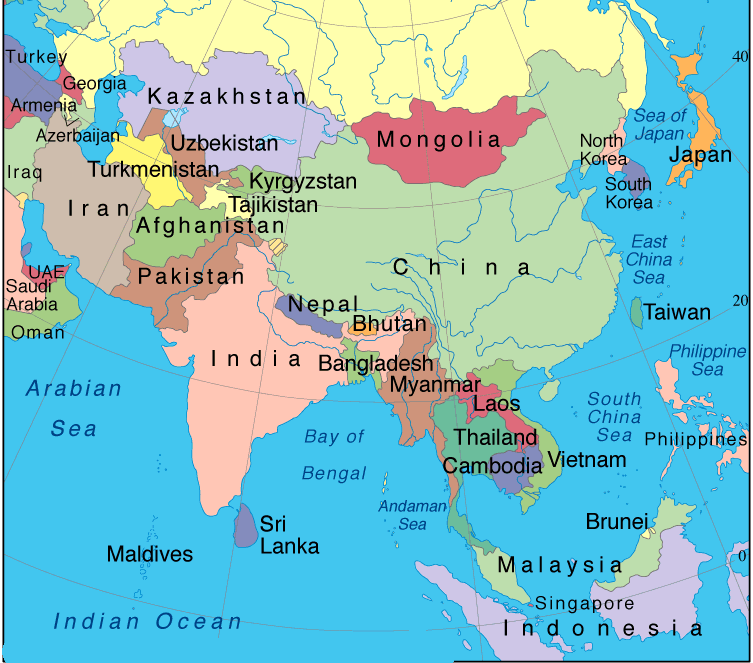
I plan to continue using this map as a reference for the heart of Tian Xia: http://upload.wikimedia.org/wikipedia/c ... en.svg.png
(keeping in mind that the 'Sichuan Basin' was submerged during the Rage of Heavens, and is now the Sìchuān Sea.)


==In the North: The Xiongnu Steppes (covering the Mongolian/Russian/Siberian steppes)==


(I hope to convince/bribe/cajole Kat for her input into the steppes region when available, if possible. She has a far more thorough grasp of steppes culture and customs) :)

As with every other aspect of Tian Xia's territories, I've gone back to the 300-200 BCE mark to determine which cultural group was most likely prevalent when the Changers' War ended and the Warring Races period got started.

For the vast steppes north of central Tian Xia, the nomadic Xiongnu are perfect: http://en.wikipedia.org/wiki/Xiongnu

At this stage, I visualise the steppes as having been one of the more difficult areas to bring under the Tian Xian banner, and probably the last area where the Tianlong Dynasty succeeded in doing so.

Whilst I imagine cities having been set up over the centuries since that point, I still visualise a large proportion of the population maintaining the Xiongnu culture and nomadic lifestyles, and friction between the citydwellers and true nomads.


==In the South: Nányuè (Covering the 'Indochine peninsular')==


--Reference links--
Zhao/Trieu Dynasty - http://en.wikipedia.org/wiki/Tri%E1%BB%87u_Dynasty

Original inhabitants:
http://en.wikipedia.org/wiki/Pyu_city-states
http://www.seasite.niu.edu/burmese/cool ... pter_2.htm
-------------------


In the aftermath of the Changer Wars' cataclysm the remaining population of the large peninsular south of Tian Xia, officially referred to by Imperial Cartographers as Nányuè, became largely influenced by the shortlived Trieu Dynasty and subsequently by the Tianlong Dynasty.

Trieu Da (born Zhao Tuo) originally conquered a large section of the southern region during the Warring Races period, and the Trieu (or Zhao, as Tian Xian historians would have it) dynasty was one of the last regions to fall before the armies of Great General of the South Tianlong Qin.

Despite the Tianlong Dynasty's influence, and early tendencies towards expansionism, large proportions of Nányuè and in particular the southern peninsular remain uncivilised and uninhabited. These regions remain part of Tian Xia in name only. That it remains as such is due to nobody in the area being aware of the fact or, if they were, organised enough to dispute it.


Southern Nányuè mostly contains jungles, jungle-dwelling tribes, island fisher folk, magic-warped creatures of all varieties, and some of the most vicious mosquitoes in all Pal Tahrenor. Monsoon season in that region can be lethal to the unwary ship captain or traveller.

Some tribes occasionally ally with a pirate captain or fleet: typically in such arrangements the tribes get trade in strange artifacts from the pirates, and the pirates get a place to hole up quietly for rest and restocking.


==Nearby independent nations==

==Wakoku (Japan)==

* Future project - if I get to it first, I would plan to model it primarily on Heian era Japan. Also: Wokou (Japanese Pirates) for sea-going aggressors.


==Gur'yeo (Korea)==

Current information from Jaspanellar's approach: http://www.tharshaddin.com/rp/viewtopic.php?f=40&t=1883

Unless Jaspanellar returns to clarify Gur'yeo further, I would like to work her vision in with mine in the following way:
I visuallise Gur'yeo as a branch of the Xiongnu people who, during the Warring Races period, gave up warfare and retreated to their peninsular. A freak event of the cataclysm raised mountains and dropped chasms along the head of the peninsular, resulting in a very defensible nation, albeit small, and not presenting enough reward for the risk of conquest by the larger Tian Xia. The biggest day-to-day risk to the Gur'yeons would be raids by Wokou - pirates from the nearby island nation of Wakoku.

As a reference: http://en.wikipedia.org/wiki/Goguryeo


==Tâi-ôan (Taiwan)==

(The name comes from a native Sirayan word meaning "foreigners")

Tribal cultures: independent villages of varying size.
Between these villages there is frequent trade, intermarriage, warfare and alliances against common enemies.

References for further expansion
http://en.wikipedia.org/wiki/Taiwanese_ ... boriginals
http://en.wikipedia.org/wiki/File:Formo ... s_2008.png

Village tribes
http://en.wikipedia.org/wiki/Siraya_people
http://en.wikipedia.org/wiki/Rukai_people

Mountain Nomad tribes
http://en.wikipedia.org/wiki/Atayal_people
http://en.wikipedia.org/wiki/Bunun_people

Re: The Empire of Tian Xia

Posted: Sat May 25, 2013 3:37 pm
by Darrik
=====Post Four: Military structure of Tian Xia=====


Overview: The Five Talons of Tian Xia


===The Northern Talon under Great General Tianlong Shun===

Weisuo system with a focus on cavalry and artillery formations protected by infantry.
(Weisuo system to be described later)


===The Southern Talon under Great General Tianlong Qin===

Weisuo system with a focus on city defense, infantry, and skirmishing tactics
(Weisuo system to be described later)


===The Western Talon under Great General Tianlong Run===

Strong focus on combat at range.
Heavy use of shifters, magic users, and Feng Shui specialists.
Cavalry garrisons of various kinds to suit the different terrains.
Elite rapid-response units ready to be transported magically to various outposts.


===The Eastern Talon under Admiral Tianlong Guang===

Navy formed of different styles of specialist ships to allow for greater strategic diversity.


===The Central Talon under Emperor Tianlong Huangdi===

Strong combination of infantry, cavalry, shifters, and magic users.
This section also contains the Jinyiwei, the Emperor's secret police.


Expanded information on the various Talons and their responsibilites


===The Northern Talon===

General Tianlong Shun's greatest challenges come from the semi-conquered Xiongnu tribes. Although most tribes find it easier to acknowledge the dominance of the Tianlong Dynasty, some of the tribes furthest from the Tianlong cities will occasionally test the readiness of Tianlong Shun's military by attempting to gain independance through force of arms.

Great cavalry armies formed of coalitions of nomad tribes then face Tianlong Shun's own cavalry alongside mobile artillery formations


===The Southern Talon===

General Tianlong Qin has a different dilemma. The Vast majority of Nányuè remains a dense jungle, with Tian Xia's influence spreading out from walled cities surrounded by croplands and paddy fields carved out of the jungle.

However, the jungle is home to many hunter-gatherer tribes whose warriors dislike having their hunting grounds cut down by Tian Xian fieldworkers.

While there is a strong disparity between the basic equipment of the tribal warriors and Tian Xian soldiers, the terrain has always favoured the tribes' predilection for hit-and-run tactics with bow and blowpipe.

General Tianlong Qin has had to adapt over the centuries, and has divided his forces into city defense and jungle border defense - the latter an ongoing-experimentation in jungle warfare and skirmishing tactics with specialist equipment.

Worse, the jungle is home to many predatory creatures warped by magic. Those without the various tribes' hard-won local knowledge of such creatures and their habits are liable to suffer their predation.


===The Western Talon===

General Tianlong Run has, in some regards, the most difficult task of all the Great Generals. He has sole responsibility for the security of a border which, for all intents and purposes, runs the length of an entire continent. Certainly, he is aided by natural barriers which limit the movement of armies: mountain ranges, deserts, chasms and the like. Nonetheless there is always the concern of a large raid into Tian Xia by desert tribesmen, or an expedition in force along either of the traderoutes.

In recognition of the immensity of this task, and of his own talent for creative strategy, Tianlong Run has been given the authority and resources to design the border defense of Tian Xia himself.

The result is an unorthodox yet effective combination of many disciplines. Amongst his cadre of specialists are
- Kan Yu masters (skilled in magics pertaining to location alignment and position, able to craft portals for troop movement)
- Shifter scouts
- Qigong martial artists
- Camel cavalry for desert warfare

Defense outposts are set up along the border, each with a portal and a small unit of watchmen. There are rigid communication protocols for each outpost, and response procedures if those protocols are not met.


===The Eastern Talon===

Tianlong Guang is responsible for staving off the attacks of Wokou pirates hailing from Wakoku, as well as the predominantly Tian Xian pirates of the Nian Fleet.

Fleet Composition:

(To be expanded on later)

* I shall take inspiration from Tang Dynasty descriptions (i.e I shall steal liberally) as per http://en.wikipedia.org/wiki/Naval_hist ... a#Tang_era


===The Central Talon===

=The Emperor's Personal Guard=

The Emperor's personal guard is itself a small army, and maintains its readiness through frequent exercises and competitions held on the Imperial Training Grounds, a large facility and barracks for those not on active duty.

Although the heart of the Tian Xia empire is mostly peaceful a lesson was learned in the early stages of the Tialong Dynasty that preparedness, even in the face of apparent peace, was necessary. The lesson came when a large group of assassins masquerading as a trade delegation attempted to kill Emperor Tianlong Huangdi and the senior members of the Imperial Secretariat. The initial efforts were thwarted by the self-sacrifice of Jinyiwei agents and imperial guards, and a pitched battle began within the walls of the Hall of Audience. Though the assassins were dealt with, the lesson of remaining prepared for an assault at all times was hammered home permanently.

While the Emperor's personal guard haven't seen a real battle as a unit in many centuries, a rostering system created in the imperial army ensures that there are always some veteran officers from each of the Great Generals in the personal guard, either as training officers or strategic officers.


=Jinyiwei=

Of more immediate importance to the Central Talon are the Jinyiwei, the Emperor's corps of specialist investigators and secret police. Hailing from many backgrounds within the greater empire of Tian Xia, they all share two traits in common: firstly, their physical and/or mental capabilities are far greater than most of their contempories; and secondly, their loyalty to the Tianlong Dynasty is absolute.

Outside of those two commonalities, the Jinyiwei have members who are skilled shifters, Qigong masters, Feng Shui masters, elites from the personal guard, acrobats, strategists, doctors, acupuncture specialists, infiltration specialists and many more.

The Jinyiwei are broken up into different areas of specialised investigation, with their primary mandates being as follows:
* Investigation and prevention of Treason
* Investigation and prevention of corruption
* Hunting of rogue/feral shifters
* Hunting of monsters

Members of the Jinyiwei are often assigned to assist provincial law enforcement where a serious/magical crime proves to be beyond the ability of local magistrates to resolve.

Re: The Empire of Tian Xia

Posted: Sat May 25, 2013 3:37 pm
by Darrik
=====Part Five: Magic and the Supernatural within Tian Xia=====


Just as with the rest of Pal Tahrenor, magic is ubiquitous within Tian Xia, and manifests in a myriad of ways.

Unlike Thar Shaddin, which has made magic illegal except in special cases, in Tian Xia magic is legal and encouraged if used for the benefit of ones community and the empire. One travelling through the vast empire might see one day a farmer 'encouraging' his rice paddies to grow more rapidly, and the next day see a labourer carrying wooden beams far too heavy for a human by aid of his personal magic. Such individuals increase the prosperity of their communities, and frequently enjoy a level of local celebrity and colourful nicknames as a result. Oftentimes, the reason why these magic users remain in their villages is simply because they are a big frog in a little pond, and like it that way.

Magic users in Tian Xia, mostly accepted and encouraged by society, generally feel less need to resort to a criminal life to get by. However, people are imperfect, and not every magic user is a kindly and generous soul. Some inevitably succumb to pride or greed, wanting to lord their powers over the people around them.

The Tianlong Dynasty has at every stage taken steps to minimise the risk of magic users destabilising the empire. The Imperial University of Magical Studies was formed by decree of Tianlong Huangdi, who saw the need to have influence over the magic users born within the empire, and had began to understand his human subjects' tendency to rationalise the energies they could subconsciously feel leaking through the imperfect seal between the material and astral planes.

With government appointments becoming available specifically tailored for magic users, and Ministry examiners rewarding communities which supplied talented children to the Imperial University, the dynasty has been able to cement itself in a position of authority over magic users without oppressing them and resorting to an endless internal witchhunt throughout the empire.

On those (still numerous, given the population) occasions where a magic user breaks the law with their powers, either magic using magistrates are sent to investigate (in the case of minor crimes) or members of the Jinyiwei (if the crime is serious, or the magic user is deemed a powerful adversary).


=====The Imperial University of Magical Studies=====

Falling under the oversight of the Ministry of Astral Influence, the University originally had three mandates:
- to study and record the seemingly unending variations of magic use, its abilities, and its limitations
- to create a means of study which, if imposed upon children, could help direct their mental processes to 'understand' magic in a way beneficial to the empire
- scout for talented individuals to serve the Jinyiwei if magic-using criminals needed to be apprehended

However, with the successes had in creating serviceable 'magical systems' with which to train talented children, the university now has a fourth mandate: to provide examiners for the various provinces to allow children to be tested for magical sensitivity.

Children brought to the university are assessed, based on personality and examiner observation, to be entered into one of several 'systems' of magical study. The University becomes their home, the Empire their parents, and they are carefully indoctrinated into strong loyalty to the Tianlong Dynasty over the decade they spend at study.

Although not every child succumbs to the indoctrination, and not every child remains secured against influence from the outside world, the majority are, and each year the empire is supplied with new mages of varying talent to be placed in auxiliary roles around the empire.


====Imperial Systems of Magic====


===Kan Yu (The Tao of Heaven and Earth / Feng Shui)===

Prior to the flourishing of magic, Kan Yu was a method of divination and geomancy, primarily designed to help orient buildings for good health and fortune.

When magic seeped into the world, it became much more.
Once the domain of a few wise masters prior to the formation of the University, Kan Yu has since become the primary Imperial system of magic, given its utility in aiding law enforcement and investigations.

At its most advanced levels, through geomantic alignment and magical symmetry, Kan Yu masters can create portals allowing the teleportation of people and things from one location to another. Advanced applications of this technique are used to aid General Tianlong Run in defense of Tian Xia's western borders.

Lower level Kan Yu practitioners often end up working as both assigned and travelling magistrates, aided in their investigations by the Kan Yu divination compass, the Luopan. Once merely an annotated magnetic compass, in the hands of a Kan Yu practitioner it can be attuned to the sympathetic energies of whatever evidence is placed in its centre to seek out that from which the evidence has come. It is crucial, though, that the evidence is chosen carefully. A piece of cloth torn from a criminal's clothes might lead a magistrate to the clothmaker two counties away, whereas a drop of blood could lead the magistrate to the criminal it came from where he is hiding a few city blocks away. This form of divination requires constant focus, and magistrates relying on it are advised to deputise a local guardsman for the duration of the investigation.


---Reference links---
Feng Shui - http://en.wikipedia.org/wiki/Feng_shui
Kan Yu's magnetic compass, the Luopan - http://en.wikipedia.org/wiki/Luopan


===Imperial Military Magic===

Not every student that comes to the University is young enough for the teachers to overcome the directions their natural talents are already leading them.

In those situations, the teachers are expected to foster the existing talent whilst taking even more care to subtly indoctrinate the students towards loyalty to the empire.

At the same time, whatever the students' talents, they are also taught the shapes and forms of shifters and other monsters which have appeared to menace communities over the many centuries of Tian Xia's history. And they are taught how to combat them.

Students are encouraged to figure out ways to use their talent in defense of themselves and the Emperor, and in the defeat of supernatural beings threatening the citizens of Tian Xia.

Though typically assigned to aid the four Great Generals, particularly skilled members of this course frequently end up in the Jinyiwei corps specifically dedicated to countering supernatural threats


===Yi Jing Talisman Exorcism===

The trigrams of the Book of Changes had existed in the region of Tian Xia even before the coming of magic, though they were used principally as a divination tool. Today, in the Imperial University of Magic, they are used as a focus for an unusual form of blood magic involved in the creation of supernatural talismans.


The Yi Jing Shenfu system of magic is unique in that it was devised by Tianlong Huangdi as an answer to the frequent appearance of incorporeal supernatural entities within the borders of Tian Xia. Sometimes it was an untrained magic user drawing too much from the astral plane, subsequently allowing the essence of some astral creature through. Sometimes, it is just a random entity formed of magic essence running rampant.

It was made clear over time that such creatures were often an incompatible opponent for most of the Jinyiwei, whose abilities were typically more suited for physical opponents. Tian Xia needed a way to subdue or seal away such entities.

The school started as a private experiment several centuries prior to present day: Tianlong Huangdi learned of an elven orphan from a small community who had approached the Emperor via the Hall of Audience for assistance in relocating the child to better living arrangements. The peasant family had brought the child, and in it Huangdi recognised an as yet un-tapped magical talent.

Officially, the child was entered into the University, and the community who had found him were rewarded for their kindness to the orphan. Unofficially, the child was adopted by Tianlong Huangdi and given the name 'Longmen Shenfu' (Dragon Gate Talisman).


==The Principles and Development of Talisman Magic==

In principle, the Astral Plane and the Material Plane are meant to be seperated. That was the natural state of things, once. However, the shattering of the seal, and its subsequent 'repair' meant that the seal was no longer perfect.

Incorporeal creatures of magic, being closely attuned to the essence of the Astral Plane, should in theory find the essence of the material plane anathema - if such essence could be distilled and focused via magic. Tianlong Huangdi, being a creature of the Astral Plane once, was not suited for the practical creation of such an art, though he had the knowledge to help another discover it. And for that he now had help.

It took a century of study and experimentation before Tianlong Huangdi and Longmen Shenfu arrived at what seemed a viable and replicable approach. The most potent form of 'Material Plane' essence they could find was in the blood of living creatures. Initially, Huangdi had thought that an elf, having strong attachment to both the material and astral plane, would be the ideal student. To their dismay, elven blood was not as well suited as they had hoped. The next step was to obtain students from different races. Shifters, gnomes, dwarves and anything tainted by the fae proved inept at creating or using the talismans. Only pureblood humans showed any aptitude.

It would take another half century before their human students would show signs of success. And in this time Huangdi and Shenfu discovered the key principles by which the Talisman Magic could work:
- Blood of a human
- A Focus for the mage to rationalise their actions
- Faith in the Magic's Efficacy

With the prevalence of the Yi Jing (Book of Changes) as both a philosophical text and divination tool amongst the citizens of Tian Xia, it was deemed an appropriate focus on which to base the magic.


==Talismans: the tool of the Exorcist==

Students of the Yi Jing system are known as Imperial Exorcists, and are highly respected.

The talismans are created on parchment prepared by the exorcist, and written at the time of the exorcism using the exorcist's own blood. The exorcist incorporates whichever sequence of Trigrams the caster feels appropriate to the entity they are attempting to seal away, incapacitate, or disperse.

The will and faith of the exorcist is the conduit through which the sealing magics are channeled, and the talismans are the focus by which they direct the sealing magic.

The process of an exorcism can be visually spectacular:
In the first stage, with a special bladed pen, the exorcist releases their own blood and rapidly paints the trigrams whilst chanting the associated precepts of the Yi Jing. This serves to aid their focus and concentrate their magic and will.

once the talisman is finished, the exorcist channels as much power through it as possible, directing it at the entity to be sealed. The talisman, carried by the magical energy, whips through the air like a thrown dart, and will seem to stick against something unseen.

For a weak spirit or entity, a single talisman from a powerful practitioner may be enough. However, often an exorcism will require multiple seals, and part of an exorcist's studies involve physical training to endure the drain of stamina and strength such an exorcism requires.


---Reference links---
http://en.wikipedia.org/wiki/I_Ching
http://en.wikipedia.org/wiki/Ba_gua


=====Spirits and the Supernatural=====

(Coming soon!)


---Reference links---
http://en.wikipedia.org/wiki/List_of_su ... e_folklore
http://en.wikipedia.org/wiki/Chinese_my ... _creatures
http://en.wikipedia.org/wiki/Yaoguai


====Qigong====


===Brief History of the Origins of Qigong===

A mating pair of Fenghuang, during their exploration of the material plane at the time of the Changers' War, discovered through their own peculiar astral senses that most creatures of the material plane had fields of energy (Dantiens) within them which seemed to act and react to the energies of the astral plane. Much like the Tianlong Shifters, the Fenghuang found themselves trapped on the material plane when the seal was restored.

Later, during the Warring Races Period, the Fenghuang were responsible for saving many peasants and refugees from the threat of bandits and soldiers alike. The Fenghuang recognised the possibility for the humans and elves they had rescued to gain varying levels of control over their dantiens. Prevented from returning to their astral home by the seal, the two long-lived Fenghuang saw in their followers a way to use their lifespans to the benefit of others whilst helping their own efforts to stave off the dangers of ennui. Promoting a simple lifestyle and a dedication to meditation and serenity, the Fenghuang founded what are now called the Western Temples and the order of Kunlun Monks.

The most successful of the Fenghuangs' early students were eventually able to perform feats of strength, speed, and endurance beyond that of a normal person. Such students would often go out into the war-torn lands of the Warring Races Period and use their newly learned abilities to save others, just as they had been saved. Inevitably, some of those rescued by the Kunlun Monks would stay on and learn from the Fenghuang.

Over the centuries, not all monks found the serenity they hoped to achieve, and some re-entered the empire of Tian Xia to roam the lands in order to find their own personal meaning. With a strong sense of protectiveness imparted upon them by the Fenghuang, such monks would often act to defend common citizens of Tian Xia from bandits, thieves, ruffians, and dangerous creatures. Some of these monks would pass on their arts to promising students.

A proliferation of martial arts spread through Tian Xia, but not all practitioners had the benevolent motivations of the monks. An increase in qigong-assisted crimes and criminals led to the misunderstanding behind the Fenghuang Prosecution of 910PW - 850PW. Eventually, after the conflict drew to a stalemate, a direct meeting between the Tianlong and Fenghuang allowed the two parties to reach a mutual understanding. Since then, the Kunlun Monks have been granted freedom of travel throughout Tian Xia, and the Fenghuang expect such monks to intervene when martial artists appear to be using Qigong for criminal or malicious purposes.


===Principles of Fenghuang Qigong===

Long before the Tianlong Dynasty founded the University of Magical Studies to shape magical talents in directions beneficial to the empire, the Fenghuang of the Kunlun Mountains were training their own followers in the arts of Qigong: a system whereby a creature of the material plane could, through lengthy and rigorous training, develop a sense of the magical energies and obtain a limited control over them using their own bodies as a focus and transmission point of that energy.

The only individuals unable to grasp the essence of Qigong are those who are, by heritage or circumstance, completely cut off from the energies of the astral plane leaking through the flawed seal.

It is exceedingly rare that those talented enough to become a fully-fledged mage would spend the time or effort to learn Qigong, the tenets of which usually conflict with the internal logic by which a proper magic user's talent develops.

As a general guideline, those least talented in sensing magic inevitably take the longest to learn Qigong, and are rarely powerful in its use (though will benefit from the physical training nonetheless).
Those whose innate talents for magic are strong but not already realised, if capable of following the rigorous Fenghuang Qigong training regimens, are likely to become powerful practitioners.

At even the basic levels, it takes a decade of physical training and preparation to manifest the supernatural aspects of Qigong.


==The Dantien, or Qi Centre==

Typically, the humanoid races have three primary Dantiens, described below. Because of this a skilled practitioner of Qigong, with a highly developed upper dantien, is able to transmit the lessons of Qigong onto students of their own. Over the centuries, this has resulted in many unique lineages of Qigong use passed down in families or groups of practitioners.

Non humanoid students of Qigong are rare, and due to the irregularity of their dantiens, typically need to be taught by the Fenghuang directly.

The training regimen implemented by the Fenghuang helps teach their humanoid students how to accumulate astral energy in their lower dantien, move it to their middle dantien, and with guidance from the upper Dantien direct it through their bodies.


=The Lower Dantien (Xia Dantien)=

Located below the navel (about three finger widths below and two finger widths behind the navel).
The Xia Dantien is associated with cultivating astral and internal energy (qi).


=The Middle Dantien (Zhong Dantien)=

Located at the level of the heart
The Zhong Dantien is associated with storing life energy (qi) and with respiration and health of the internal organs, in particular the thymus gland.


=The Upper Dantien (Shang Dantien)=

Located behind the forehead between the eyebrows.
The Shang Dantien is associated with the energy of consciousness and spirit (shen) and with perception of astral energy


==The Two Styles from which all others descend: Feng Qigong and Huang Qigong==

As with everything else to do with magic in Pal Tahrenor, there are a myriad of individual variations in how a martial artist will express their qi. At present time there are countless lineages and traditions of martial arts use in Tian Xia - but all descend from the Kunlun Monks in some way, and as a result there are two broad 'styles' or philosophies of martial arts and Qigong use in Tian Xia dependant on which of the two Fenghuang the art has derived from.


=Feng Qigong=

The male Fenghuang, Abbot Feng, emphasises external transmission of qi in his teachings.

The principle of Feng Qigong is to meet force with force, utilising the mechanics of movement to cut into an opponents attack or to undermine their defense.

Adherents to this style (and its many derivative branches), are known for their fast movements, spectacular acrobatics and powerful strikes.

Training in Feng Qigong starts with building up the physical strength and speed of students prior to implementation of the Qigong training. The strenuous and lengthy physical training ensures only determined and focused students can learn Feng Qigong.

Popular use of Qi in Feng Qigong can include, but isn't necessarily limited to:
- Increasing the rate of energy transmission in a punch, increasing damage and oft-times sending an opponent flying
- Focusing the qi in their dantiens to reduce the effect gravity has upon them, allowing for incredible feats of aerial acrobatics
- Transmitting force over a short distance, or through solid objects, allowing the user to potentially ignore armour or shields


=Huang Qigong=

The female Fenghuang, Abbottess Huang, emphasises the retention and manipulation of qi within the body.

The principle of Huang Qigong is to yield to force and use relaxed leverage to redirect it, using the aggressor's own efforts to undermine their attacks before countering them.

Adherents to this style (and its many derivative branches), are known for their soft, graceful movements and devastating counters.

Training in Huang Qigong starts with stance training and breathing exercises. Both physically demanding and monotonous, only the truly patient and focused of students progress far enough to learn Huang Qigong

Popular use of Qi in Feng Qigong can include, but isn't necessarily limited to:
- Iron Flesh techniques, where Qi is condensed at the surface of a practitioner's body, allowing a prepared practioner to deflect the blows of weapons (the focus required for this prevents a practitioner from attacking at the same time.)
- focusing the qi in their dantiens to permit them to exert their gravitic influence in unusual directions (such as walking up a wall)
- Acupressure attacks and healing, using qi to disrupt or repair the flow of magical energy in a humanoid's body.

Re: The Empire of Tian Xia

Posted: Sat May 25, 2013 3:38 pm
by Darrik
=====Part Six: The Legal Code of Tian Xia====


For the Tianlong Dynasty to manage an empire as large as Tian Xia, It was determined at the start that an effective system of laws and law enforcement would be necessary.

What initially started as a simple system of punishment for a short list of crimes has, over the centuries, developed into a complex system of determining the severity of a crime and assigning punishment for those crimes on the basis of numerous exacerbating or mitigating factors.

Depending on the magnitude of the crime, punishment can range from beatings with light sticks, beating with heavy sticks, strangulation, and decapitation. Fines, brands, tattooing, reduction of social standing and exile can be included in punitive measures for certain crimes.


====Crime and Punishment====

At its core, the principles of Tian Xia laws are simple. The majority of crimes committed by citizens generally fall under the categories of theft, assault, corruption, murder, and treason.

The maximum physical punishment prior to death sentences is 100 strokes of the heavy stick.


===Theft===

Theft covers a vast range of possible crimes from petty pickpocketing to acts of piracy (in those instances where no blood is shed)

For petty crimes, beatings with the light stick are common.
For more serious crimes, the heavy stick is used.

Criminals punished twice for serious thefts receive a tattoo behind their left ear. The next time they are assigned punishment, a second tattoo is inked behind their right ear.
Any criminal apprehended for a serious theft who has two such tattoos already is executed by strangulation.


===Assault===

Petty assaults, where no lasting damage is caused, are typically punished using the light stick.
Serious assaults, where the victim is badly hurt (broken bones, etc), are punished using the heavy stick.

Criminals punished twice for serious assaults receive a tattoo on their left palm. The next time they are assigned punishment, a second tattoo is inked on their right palm.
Any criminal apprehended for a serious assault who has two such tattoos already is executed by strangulation.


===Corruption===

Almost a second set of laws, the rules with regards to correct and meritorious conduct for Imperial officials are incredibly complex. Whilst, at a first glance, they may seem forgiving (Emphasis on beatings with light sticks, fines, demotions, and so forth) there are many more ways for a member of the Three Departments and Six Ministries to fall afoul of the law. Negligence, failure to discharge duty in a timely fashion, irresponsible delegation: in broad terms, laziness and lack of focus can easily lead an official into a legal pitfall.

These laws cover major and minor aspects of the Imperial Infrastracture of Tian Xia, and knowledge of these particular laws are a major facet of the Imperial Examinations.


===Murder===

In general, the crime of murder is punished by death.

Particularly vile crimes in this category, or sequential killings prior to capture, might result in a set period of torture prior to the final execution.

In certain circumstances, mitigating factors may reduce the degree of punishment to something less severe than death, as determined by the deciding magistrate.


===Treason===

Strictly speaking, Treason is the most serious crime within Tian Xia.
Treason covers crimes from the attempted (or successful) assault or murder of any within the Imperial Enclosure, attempts to destabilise the dynasty (rebellions, etcetera), or the deliberate disruption or destruction of critical Imperial infrastructures. The latter can be as simple as assaulting, killing, or robbing an Imperial Messenger, publicly burning Imperial Proclamations, and attempting to incite rebellion. It can be as grandiose as arson of granaries and libraries or the destruction of bridges.

Treason is a broad term within the context of Tian Xia law, not simply an assault on the ruling family. As such, the laws recognise degrees of culpability with regards to the actions and role taken by individuals responsible for crimes falling under the category of Treason.

Those responsible for instigating the treason always receive the level of punishment appropriate for the severity of the crime.
Accomplices receive punishment reduced by one degree of severity.
Supporters of the instigators, if unaware of the treasonous nature of the crime being planned, may receive punishment reduced by two degrees.


====Law Enforcement within Tian Xia====

Broadly speaking, there are two main agencies involved in prosecuting the Imperial Laws: The Magistrates, and the Jinyiwei.

However, the public face of the law are the Magistrates of the Ministry of Justice.


===Magistrates===

The role of Magistrate is one of respect and responsibility within Tian Xia society.
Passing the Imperial Examination for this role requires great intelligence, focus, and a flawless memory of Tian Xia's laws.
The most successful magistrates within Tian Xia also possess wisdom, an insight into sentient nature, and a broad understanding of many fields of study, from medicine and physiology to toxicology and commerce.

There are two kinds of Magistrate within Tian Xia: Regional and Travelling Magistrates.


==Regional Magistrates==

These magistrates are responsible for dispensing justice and reporting on the criminal happenings of a fixed area, ranging from Town, County, Province, and Region.

Due to the centralised nature of their work, regional magistrates are supported by a staff of subordinates to help enact Imperial Justice. A magistrate's prominence tends to determine the number and quality of subordinates available to them.

Typically, however, a regional magistrate's staff will always have the following roles staffed:


=The Principal Investigator=

Responsible for examining each case within the Magistrate's jurisdiction, to ensure the Magistrate has enough facts to pronounce an appropriate judgement. The better ones have training in medicine and physiology to more reliably examine victims of serious crimes.


=The Principal Secretary to the Magistrate=

Responsible for recording all judgements and ensuring accurate monthly reports are forwarded to the Magistrate's superiors.


=The Dispenser of Chastisement=

Responsible for carrying out the physical punishment. Chastisers are respected, but not often well liked, and perform a difficult but necessary role in Tian Xia.

Beatings, Tattoos, and Strangulations are carried out by Chastisers. At the Town and County levels, Chastisers are often ill-equipped or trained to carry out decapitations or torture. Criminals requiring such punishments must therefore be transported to that province's head Magistrate for execution.


=Bailiffs=

Members of Tian Xia's military assigned to Magistrates to assist in the capture and holding of criminals.


==Traveling Magistrates==

Travelling magistrates form an elite within the Ministry of Justice. When an applicant shows above average qualities in the Imperial Examination, they are given the option to undergo additional training to earn the right to enter the Examinations for Travelling Magistrates.

Some criminals, relying on a county or province's jurisdiction to extend only as far as its borders, roam Tian Xia like nomads. Operating under the guise of 'travelling merchants', or similar ploys, it can be difficult to locate and prosecute such people. It became apparent several centuries ago that Magistrates with jurisdiction across the entirety of Tian Xia would be necessary to counter such criminals.

Travelling Magistrates must have all the qualities of a regional magistrate, but also require the skills of all a magistrate's staff. While a travelling magistrate does have a minimum allotment of subordinates accompanying them, if one or all are incapacitated or killed, the travelling magistrate is expected to be able to perform all those tasks in a pinch.

Due to the training a magistrate normally undergoes to obtain this position, it is rare for a travelling magistrate not to have combat experience of one form or other. It is not uncommon for travelling magistrates to have minor magical talents. (Those with major magical talents tend to be seconded to the Jinyiwei instead, where their talents will be better utilised.)


A Travelling Magistrate is required report in with each regional Magistrate's office. At this time they must perform three tasks:
1. Record their presence and current destination.
2. Lodge any reports to be lodged for onforwarding to the capital.
3. Examine the local Magistrate's reports of uncaptured criminals and unsolved crimes

In this way, if a Travelling Magistrate goes missing, the JinyiWei investigators know where to begin their enquiry. It benefits the Travelling Magistrate to compare notes between offices to see if there are indications of crimes spreading between counties and provinces. Finally, it means that the loss of a magistrate does not necessarily mean the loss of all evidence for their current investigations.

=With regards to seniority in investigations=

In the pursuit of criminals crossing jurisdictional boundaries, the Traveling Magistrate is given seniority for an investigation.
If a travelling magistrate chooses to assist a local magistrate in one of their cases, the local magistrate has seniority.


===Jinyiwei===

(Section likely to be expanded further)

There are three sections of the Jinyiwei which have an active role in official law enforcement. Members of these sections are occasionally assigned to assist the efforts of magistrates.

1 section specialised towards investigating corruption
1 section specialised towards investigating treason
1 section specialised in apprehending criminals using magic or supernatural powers.

Jinyiwei always have seniority in their investigations.


---Reference Material---
The Ming Code: http://books.google.com.au/books?id=h58 ... &q&f=false

Re: The Empire of Tian Xia

Posted: Sun Jun 02, 2013 5:28 am
by Darrik
=====Part 7: The Jinyiwei=====

The Jinyiwei, or Fourteen Blades, are the Tianlong Dynasty's answer to the question 'Who watches the Watchmen?'

Sometimes referred to as the 'The Emperor's Tail', 'The Emperor's Bodyguards', and 'The Emperor's Magistrates', the Jinyiwei have been celebrated in popular storytelling for many centuries. A good Tian Xian Ghost story is just as likely to feature a member of the Jinyiwei as it is a Yi Jing Exorcist. The stories inevitably feature colourful and unlikely protagonists with extreme levels of skill battling unlikely demons. A role which, to be fair, a small percentage of the Jinyiwei are called upon to perform in the defense of the empire's stability.

In truth the Jinyiwei form a complex organisation, with a wide range of activities, making them more akin to a secret police than a military unit. The Jinyiwei have two broad areas of interest: magical threats, and threats to the heart of empire via corruption or treason.

Thus, the Fourteen Blades are loosely separated into two primary sections: The Blades Which Preserve Balance, dealing mostly with magical threats; The Blades Which Pierce Deceit, dealing mostly with uncovering corruption and treasonous activity.


=Recruitment=

The Jinyiwei are recruited through numerous means, but the most common method of entry into its elite ranks tend to be one of three primary paths:
* Exceptionally gifted Magistrates and Magistrate Examinees
* Talented graduates of the Imperial University of Magical Studies
* Members of the military who show exceptional ability in their duties

==Training==

However an individual comes to the attention of the Jinyiwei, those deemed worthy of making an application to the ranks are typically provided a grant to take on additional training and examination to determine if they qualify for entry into the Jinyiwei. Training for the Jinyiwei is tailored to the individual, focusing not on their already acknowledged strengths, but rather on the areas in which they are lacking.

A knowledgeable magistrate with a keen insight for analysing the smallest details of an investigation would find their training to be more on the physical side. A skilled soldier might find themselves poring over the laws of Tian Xia and learning methods of memory retention and how to understand the hidden language of non-verbal cues.

The training also helps to determine if the applicant is also mentally and emotionally suited to the harsh and unending role of the Jinyiwei, which could be more rightly called a way of life than a simple job.

It is said of the Jinyiwei: "The sword is never sheathed, and only ceases being a sword when the blade breaks."
Few Jinyiwei die of old age.


==Emperor's Chosen: The Dragon Guard and the Blood of the Tianlong==

In principal, all Jinyiwei are equal in status. There is, however, a faction within the Jinyiwei who are trusted above all others: the incorruptible Dragon Guard.

Those Jinyiwei whose devotion to the Emperor is without question are offered the privilege of imbibing an alchemical mixture containing blood of each of the Tianlong. Those who take the blood of the Tianlong into their systems are given absolute trust, and the privilege of becoming part of the Imperial Household.

But this privilege comes at a cost: the mixture, whose ingredients and composition is known only to the Tianlong, creates a permanent physiological change within those who drink it. A Dragon Guard's thoughts can never be concealed from any of the Tianlong shifters. Their minds, thoughts, and emotions are an open book which the Tianlong can read at will. Dragon Guard will register to those whose senses are attuned to Astral energies. Those Jinyiwei who have drunk 'The Blood of the Tianlong' also develop a golden sheen to their eyes. It is almost impossible, short of powerful illusory magic, for a Jinyiwei to hide this discolouration which marks them out as a member of the Dragon Guard.

It is typical for each Tianlong shifter to have a pair of Dragon Guard as part of their formal entourage, and any investigations into treason or corruption are inevitably headed by one of the incorruptible Dragon Guard.

However, those Jinyiwei who do not partake of the mixture are in no way discriminated against.
Some Jinyiwei in fact, whose strengths lend themselves to stealth, are discouraged from becoming Dragon Guard due to their subsequent visibility on the Astral spectrums.


=Organisation Structure=

==The Blades Which Preserve Balance==

This section is where the most physically and magically capable of the Jinyiwei tend to be assigned.
These Jinyiwei are responsible for the capture, containment, or destruction of the supernatural entities which serve to threaten the empire's stability.

* Yaoguai (malevolent ghosts)

* Shifters

* Monsters

* Rogue Martial Artists

* Magic Users guilty of violent crimes

* Magic Users guilty of serious non-violent crimes

* Corruption in the Ministry of Astral Affairs

* Bodyguards to the emperor


==The Blades Which Pierce Deceit==

This section tends to be filled with talents related to investigation and analysis, and are responsible for investigating treasonous and corrupt activities within the government itself.
However, the physical training required to achieve entrance even into this section puts the Jinyiwei at above the average level of the vast majority of bureaucrats

* Deaths and Disappearances of government officials

* Corruption in the Secretariat and Edict Examination Bureau

* Corruption in the Ministry of Personnel

* Corruption in the Ministries of Revenue and Works

* Corruption in the Ministry of Justice

* Corruption in the Ministry of Defence

Re: The Empire of Tian Xia

Posted: Fri Jul 05, 2013 10:48 pm
by Saruna
No capital has been decided for Tian Xia, so you're free to make one up!

I would indeed just make a new thread for the Fenghuang Monks and the Kunlun Temples, so that way we can keep it separate from the structure/history of Tian Xia.

This part:
=Recent Events of the Past 50 Years=
Is it something you've brought up to Frug? If not I'm gonna make sure he sees it to ensure it's something he's cool with.

One thing that struck me as I'm reading through the ministries -- the Ministry of Astral Influence in particular: is there any kind of magic that the empire isn't okay with? Any in particular they regulate?

Love the Ministry of Works -- exactly what I'd expect from ocd dragons. Heheh.

Detail with the tokens is awesome.

As the player who developed the Homunculi has left us as of April (I think it was), once three months with no activity have passed (end of july) I would like to work with you on adapting her world dev post in order to help it suit what you're doing with tian xia.

Jasp's player has had a child since leaving Thar, and is unlikely to return. I can ask Frug to see if she'd be willing to splurge any remembered plans/thoughts on Gur'yeo (he's still in contact with her), but otherwise you can do with it what you put down.

Love the Southern Talon

Under the Emperor's Personal Guard under Central TAlon -- as this event was something that has informed how Tian Xia feels about preparedness, perhaps it is worth sticking as a note in the outline of Tian Xia's history?

Under Imperial Military Magic -- are there any courses or types of magic used by the military? What you have in there is great, but I was expecting something a little more military focused under that heading. Like how the military regulates magic users within their ranks, or if they sorta take/encourage particularly skilled users to join.

I really enjoyed the section on how exorcism works

Qigong *coughcough* . . .did you mean mating or mated pair?

The section on law is very well thought out and implemented. I really like the idea of travelling magistrate. Even though you're pulling heavily from china, it's still well compiled.

You have a few places throughout that specify the jinyiwei with notes for expansion; I'd like to see them put just to one place in particular so as to not have bits and pieces of information floating around (except as mentions in other sections).


For ease -- when you make any more significant changes please bold or use a different color so I can spot them quickly. As is I love the direction you're going in with this! It's making the entire empire a rich place for ideas with a structure that still leaves a lot of places open for rp.

Re: The Empire of Tian Xia

Posted: Fri Jul 11, 2014 8:18 am
by Ryu Jun-Seong
I hope you know what you've done.

http://www.cems.uvm.edu/~txia/

Re: The Empire of Tian Xia

Posted: Sun Oct 26, 2014 4:37 am
by Diego
==Naming Traditions within Imperial Tian Xia==

Surnames for those citizens born in Central Tian Xia primarily tend to be formed in one of three ways, with the Census Officers of the Ministry of Revenue having particular processes by which such names are recorded.


===Location===

The greatest percentage of surnames are formed based on a citizen's place of birth. Due to a cultural emphasis on family and community as the cornerstone of Tian Xian civilisation, the vast majority of Tian Xian citizenry rarely stray far from the towns or villages where they were born. Thus, for the purposes of the Imperial Census, they adopt the name of their town or village as the surname for such reports.

Informally, it is common within a town or village to distinguish individuals with identical given names by some kind of descriptive nickname. So while there may be three men in the Wei Province's Census as'Beihu Jian' (Jian of Beihu village), the village would likely know them as 'Split-lip Jian', 'Woodcutter Jian', and 'Laughing Jian'. Census records are kept accurate, where possibly, by maintaining geneological records as part of the census-taking process.

Those who are travelling outside of their province at the time of a census would give their name as 'Beihu Jian of Wei Province', as well as their parent's names, to fulfil their obligations to the Ministry of Revenue.


===Profession===

Sometimes a family or an individual will advertise their profession as their surname. Certainly, it is not uncommon for a family profession to have stretched over generations of the same bloodline.

Thus one might see a 'Carpenter Chen' of Beihu village, Wei Province, in the census.


===Descriptive===

This is not particularly common amongst general citizenry. However, there are some whose ancestry is questionable, or who do not wish their actions to reflect back upon their home or family. This trend in naming is most common among criminal classes, but there are some travelling magistrates and Jinyiwei who have been known to take names which reflect their appearance or abilities.

While criminals tend not to fulfil their obligations with regards to the Census, those citizens who have other reasons for the unusual name choice will typically give their name, place of birth, and parents' census information.